
Most people associate SWOT analysis with business strategy. But what if you could turn that same powerful tool inward and use it to shape your personal life? A personal SWOT analysis helps you identify your strengths, understand your weaknesses, spot opportunities, and prepare for potential threats so you can live a more intentional, fulfilling life.
What is a SWOT Analysis?
SWOT stands for Strengths, Weaknesses, Opportunities, and Threats. Businesses use it to evaluate strategy, but this framework can be just as effective for self-reflection and personal growth. By exploring each category across different life domains — physical, mental, emotional, spiritual, and social — you can gain a comprehensive view of where you stand and where you want to go.
Strengths
What do you do well? What are your natural talents, skills, and resources?
- Physical: Are you strong, healthy, or disciplined in your fitness routines?
- Mental: Are you a clear thinker, a quick learner, or great at problem-solving?
- Emotional: Do you stay calm under pressure, show empathy, or bounce back from setbacks?
- Spiritual: Do you have a strong sense of purpose or guiding beliefs that ground you?
- Social: Are you a good listener, a supportive friend, or someone who builds strong connections easily?
Weaknesses
Where do you struggle? What habits or gaps hold you back?
- Physical: Do you neglect sleep, struggle with consistency, or experience chronic health issues?
- Mental: Are you easily distracted, prone to self-doubt, or rigid in your thinking?
- Emotional: Do you react impulsively, avoid difficult feelings, or have trouble managing stress?
- Spiritual: Are you disconnected from your values, or do you lack a clear sense of meaning?
- Social: Do you isolate yourself, struggle with boundaries, or avoid conflict at all costs?
Opportunities
What possibilities are on the horizon? Where can you grow or improve?
- Physical: Could you start a new fitness challenge, improve your nutrition, or prioritize recovery?
- Mental: Could you learn a new skill, read more, or practice mindfulness to sharpen focus?
- Emotional: Could you develop healthier coping strategies, or work on emotional regulation?
- Spiritual: Could you reconnect with your values, start a reflective practice, or engage in a community that supports your growth?
- Social: Could you deepen existing relationships, expand your network, or seek mentorship?
Threats
What external challenges or internal patterns might derail you?
- Physical: Are injuries, chronic illness, or poor habits undermining your goals?
- Mental: Are negative thought patterns, burnout, or information overload holding you back?
- Emotional: Do you struggle with unresolved past experiences, or fear of vulnerability?
- Spiritual: Are you experiencing a loss of purpose, or feeling disconnected from what matters most?
- Social: Are toxic relationships, lack of support, or social pressures creating obstacles?
Applying SWOT to Your Life
Grab a notebook and divide a page into four quadrants. Start by honestly listing items in each category.
- Strengths: Maybe you’re resilient, a great communicator, or highly disciplined.
- Weaknesses: Perhaps you procrastinate, avoid conflict, or struggle with self-doubt.
- Opportunities: Is there a new job opening, a chance to learn a new skill, or a supportive community you could join?
- Threats: Think about economic uncertainties, toxic relationships, or health issues.
This exercise isn’t about self-criticism — it’s about self-awareness.
Once you have your lists, the real power comes from exploring the connections between the categories:
Align Strengths with Opportunities
Ask yourself: How can I use my strengths to take advantage of these opportunities?
For example, if you’re a disciplined person (strength) and there’s a chance to train for a triathlon or start a challenging new course (opportunity), your discipline becomes the bridge to help you succeed.
Minimize Weaknesses to Protect Against Threats
Think about how your weaknesses might make you vulnerable to threats — and what you can do to mitigate this.
For example, if self-doubt (weakness) might hold you back from pursuing a new career path, and job instability (threat) is looming, addressing your confidence through therapy or coaching could help protect you.
Use Strengths to Overcome Weaknesses
Reflect on how your strengths can help you improve or compensate for weaknesses.
For example, if you’re great at planning (strength) but tend to procrastinate (weakness), creating detailed action plans can help you stay on track.
Turn Threats into Opportunities
Sometimes, a potential threat can actually become an opportunity in disguise.
For example, if a job layoff (threat) is possible, it might become the push you need to finally start your own business or change to a more fulfilling career (opportunity).
Turning Insight Into Action
Once you’ve completed your personal SWOT, ask yourself:
- How can I use my strengths to seize opportunities?
- How can I minimize weaknesses and protect against threats?
- What new habits or boundaries do I need to create?
By answering these, you start transforming abstract self-knowledge into concrete action steps.
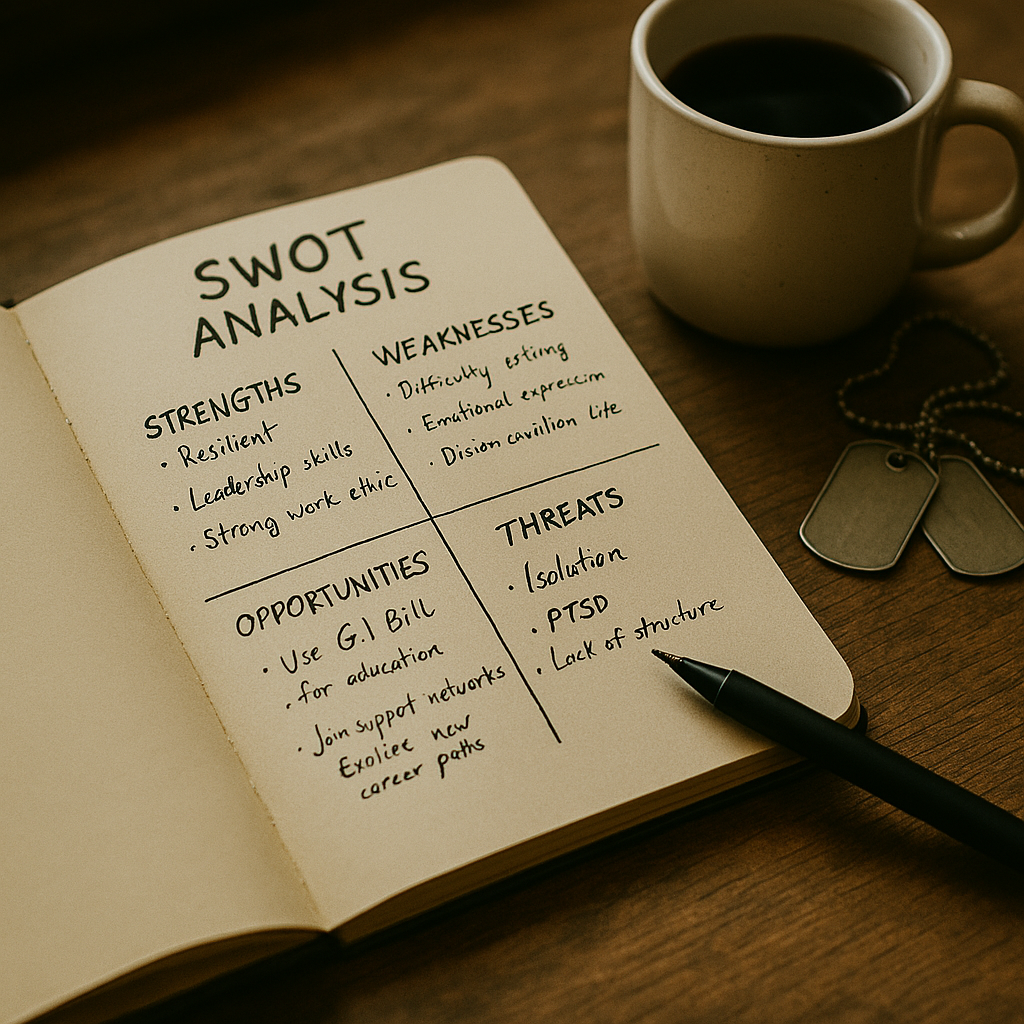
For example, consider a veteran transitioning to civilian life. After completing a personal SWOT analysis, they might identify strengths such as discipline, leadership experience, and strong problem-solving skills. Weaknesses could include difficulty asking for help, challenges with emotional expression, or feeling disconnected from civilian culture. Opportunities might include using the GI Bill to pursue further education, joining veteran support networks, or exploring new career paths. Threats might involve isolation, mental health challenges like PTSD, or a lack of structure.
By connecting these insights, this veteran could decide to use their discipline and leadership strengths to excel in a new academic program or take on a leadership role in a local organization. To protect against threats and minimize weaknesses, they might start therapy or join a peer support group to work on emotional expression and stay connected.
New habits could include setting a daily routine that provides structure, scheduling regular check-ins with supportive peers, or committing to mindfulness practices to help manage stress and maintain focus.
Through this intentional process, abstract self-awareness transforms into practical, empowering steps — paving the way toward a more purposeful and connected life after service.
Living a Life Aligned With Your Values
A SWOT analysis is just the start. Pair it with your core values to make sure you’re moving in a direction that feels authentic and meaningful. When your goals align with who you are at your core, you stop simply surviving — and start truly living.
If you find it challenging to clarify your values or take the next steps on your own, working with a counselor can help you uncover deeper insights and create a personalized plan forward.
So What?
If you want to live a life by design, not by default, a personal SWOT analysis is a powerful first move. You’ll gain clarity, set strategic goals, and build a life that feels both challenging and deeply satisfying.
Challenge
Set aside 30 minutes this week to complete your personal SWOT analysis. Take one small action afterward. Even a single step forward can create momentum.
Thanks for Reading
If you’re looking for practical tools to build resilience, mental clarity, and physical well-being, you’re in the right place. Tactics Total Wellness is based in Charleston, South Carolina, and I write weekly about mindset, performance, and integrated living for veterans, first responders, and high performers across the Lowcountry.
👉 You can explore more insights at www.tacticstotalwellness.com/blog
📬 Want tips like this delivered straight to your inbox every Sunday?
Sign up for the newsletter here: www.tacticstotalwellness.com/news-letter
💬 You can also learn more about my work as a counselor and how I help clients build strength, clarity, and direction here: https://tacticstotalwellness.com/about/
If you found this article helpful, please consider sharing it with a friend, co-worker, or family member.
Thank you for the support!
